
The Living City
Intel were late to the AI party, playing catchup to players like Nvidia that dominated the first wave training and running colossal models in the cloud.
Rather than simply outcompeting the competition on raw compute, they took a broader strategy nicknamed ‘AI everywhere’ that would bring AI to a wider audience, on a wider gamut of devices to address the affordability, privacy, security and power consumption issues.
The ask was to leverage the entire suite of new Intel silicone and services to demonstrate and communicate their AI capability in a single, integrated experience that showed not just the products but the wider corporate strategy.
Our big idea?
The AI Living City An ever-changing, human-driven experience that embodies Intel’s AI ecosystem – invites guests to play, collaborate and learn how Intel is making AI accessible to everyone – everywhere.

AI ON DEVICE
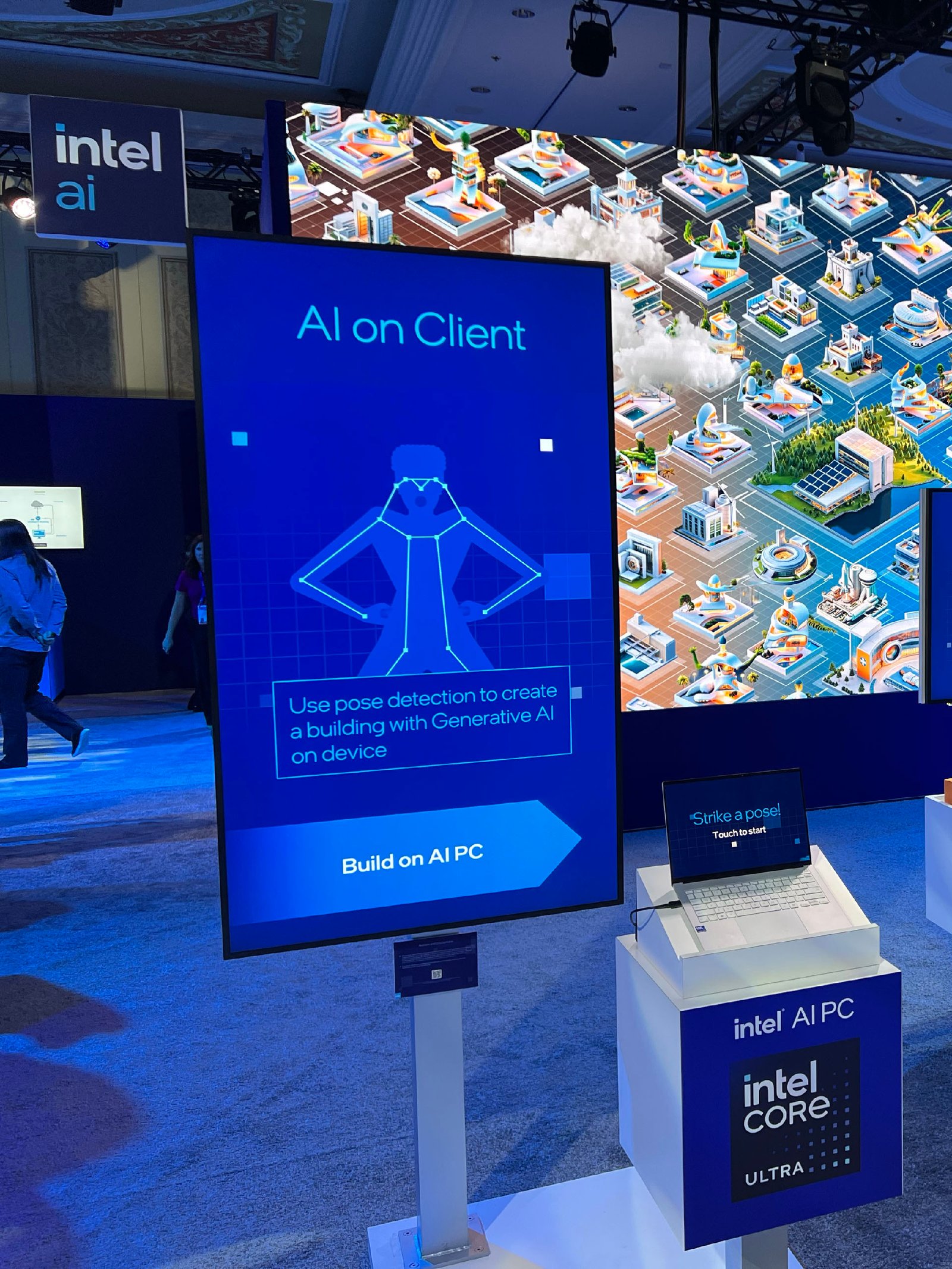
Guests pull a pose to see their bodies converted into recognisable fluid architectural forms.
Pose detection was running on the super efficient NPU on device, with images generated locally.
AI AT THE EDGE
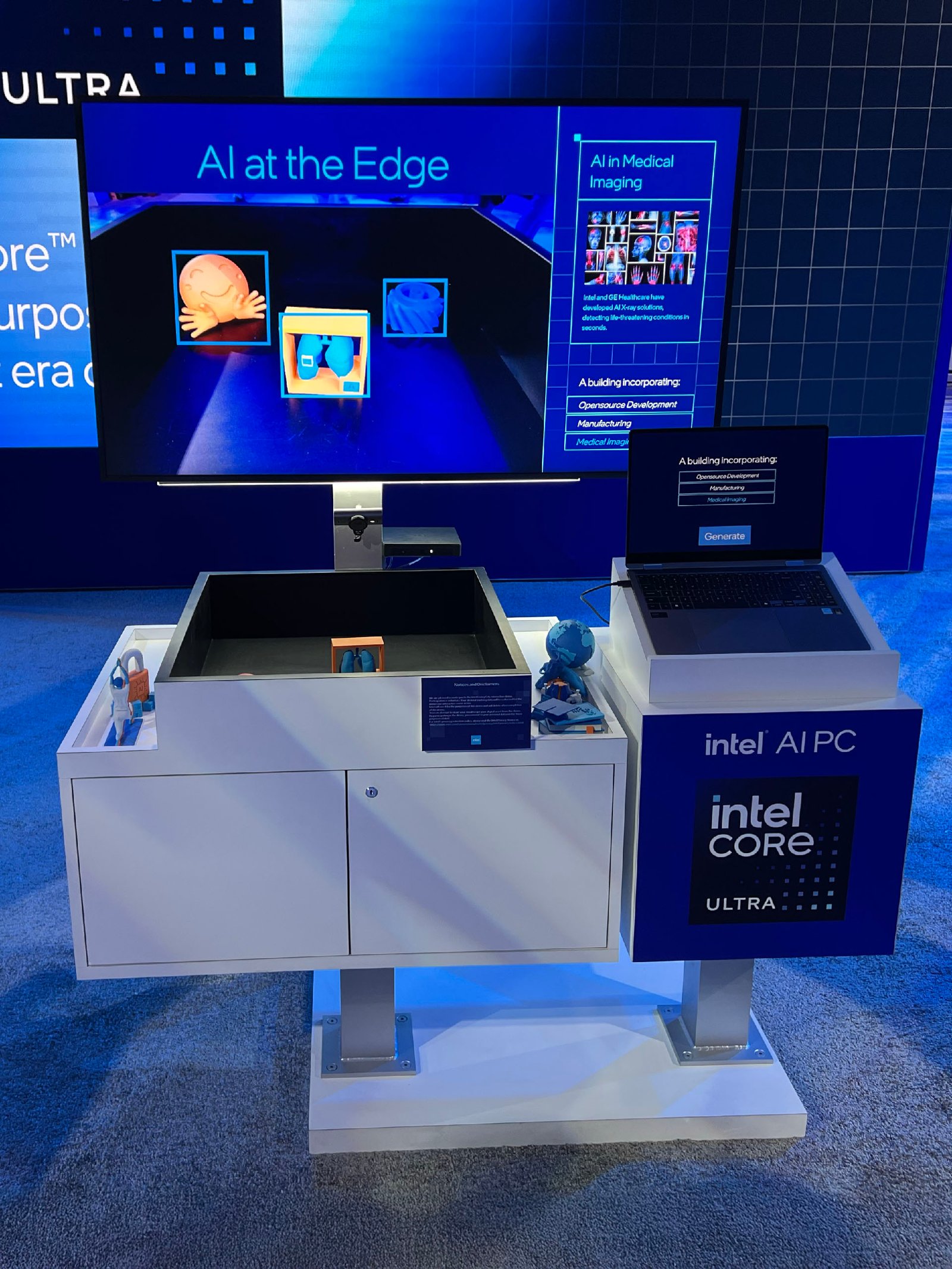
Guests place bespoke 3D-printed objects in front of a camera running object detection to configure a building based on the sectors Intel is already revolutionising with AI.
A dedicated edge device was running YOLO5 trained on a blend of real photographic and synthetic data to recognise the 3D printed objects.
AI IN THE CLOUD
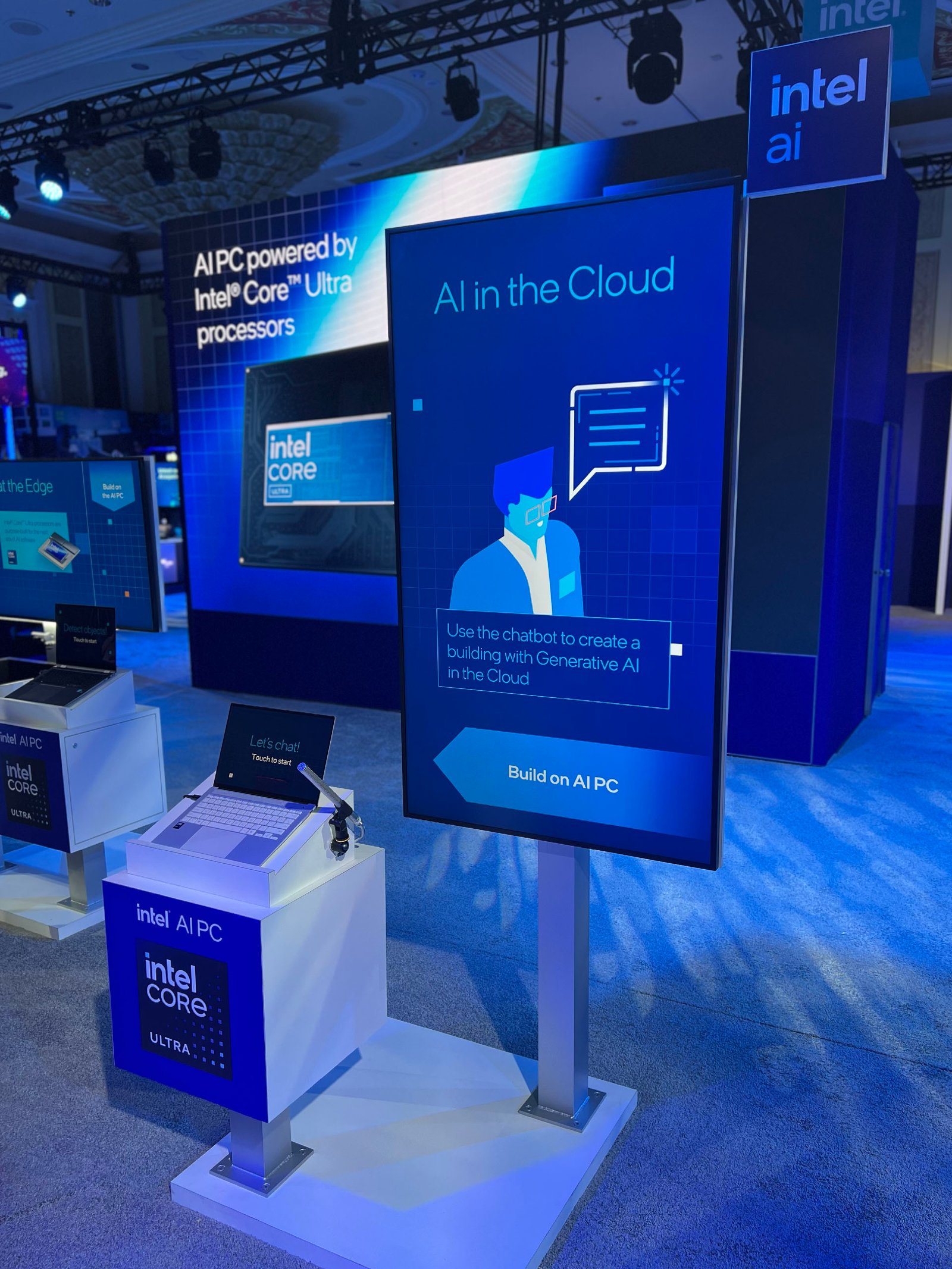
Guests have a short but entertaining exchange with a chatbot that assumes the role of design consultant to design and generate your building.
The chatbot was running in the cloud on dedicated Gaudi AI accelerators using Meta’s LLAMA 2 – whilst the asset generation required custom python rewrites of our ComfyUI workflow to run on Linux.
AI ON DEVICE
Guests pull a pose to see their bodies converted into recognisable fluid architectural forms.
Pose detection was running on the super efficient NPU on device, with images generated locally.
AI AT THE EDGE
Guests place bespoke 3D-printed objects in front of a camera running object detection to configure a building based on the sectors Intel is already revolutionising with AI.
A dedicated edge device was running YOLO5 trained on a blend of real photographic and synthetic data to recognise the 3D printed objects.
AI IN THE CLOUD
Guests have a short but entertaining exchange with a chatbot that assumes the role of design consultant to design and generate your building.
The chatbot was running in the cloud on dedicated Gaudi AI accelerators using Meta’s LLAMA 2.
ASSET CREATION
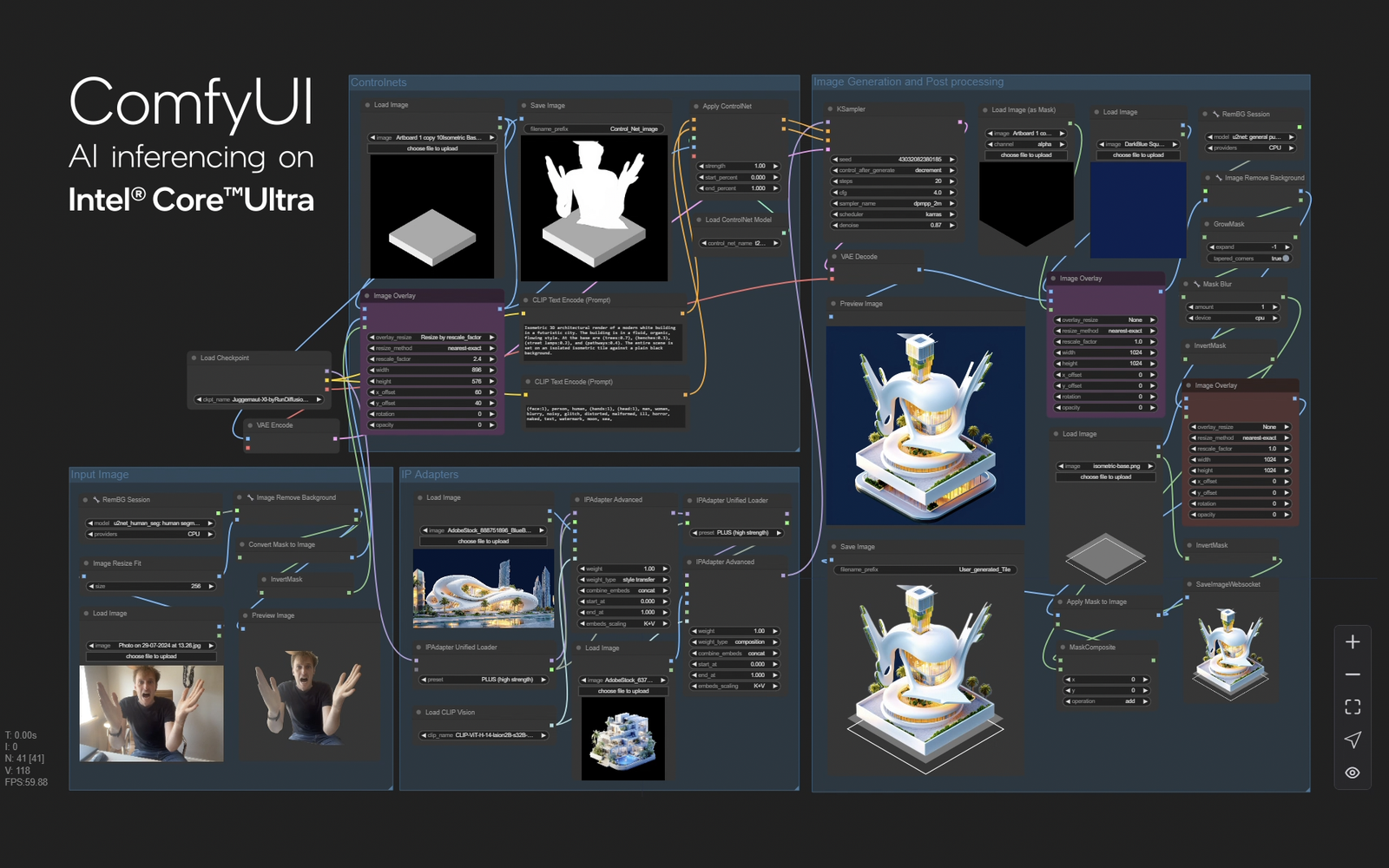
For the first two activations we generated assets using dedicated ComfyUI pipelines, honed to create a consistent art-direction and format.
The Gaudi AI accelerators running in the cloud only run on Linux so we had to rebuild the pipeline in python to accomodate.
Along with the breadth and complexity of the experience build, a major challenge for this project was that many of the existing AI systems and libraries we wanted to use were built to run on Nvidia GPU’s. We had to rebuild, rewrite and optimise these pipelines to run exclusively on Intel silicone – which turned out to be very capable.
The creative experimentation and development came in striking a balance between a visual consistency, giving our audience creative control and building distinct experiences to showcase the breadth of the AI hardware and capabilities.
The modular nature of the experience allowed it to tour for a whole year, turning up in different form factors from an intimate Davos showroom for WEF to a 10 meter panoramic curved wall at MWC.



JACK X – PART OF JACK MORTON FOR INTEL
The team behind the project includes:
SEBASTIEN JOUHANS, ELENI WILLMOTT, SHADI EL HAJJ, PATRICK DAWID, KEL PHILLIPSON, BOB HATAMIAN, JON FIDLER, HARRY BRENTON, CHARLIE RICHARDSON, HARRY WAKELING, RORY CULLEN, HOWARD BOLAND, LORENZO CAMPANIS, JOE PANEPINTO & NATALIA WILKOSZEWSKA